Chapter 25 Suicide and Attempted Suicide
Epidemiology
Suicide Completions
Suicide is very rare before puberty. Rates of completed suicide increase steadily across the teen years and into young adulthood, peaking in the early 20s. Males complete suicide at a rate 4 times that of females and represent 79.4% of all suicides. Firearms remain the most commonly used method of completing suicide for males, whereas females are more likely to complete suicide by poisoning (Fig. 25-1). In the past 60 yr, the suicide rate has quadrupled among 15-24 yr old males and has doubled for females of the same age. The male:female ratio for completed suicide rises with age from 3 : 1 in young children to approximately 4 : 1 in 15-24 yr olds, and to greater than 6 : 1 among 20-24 yr olds.
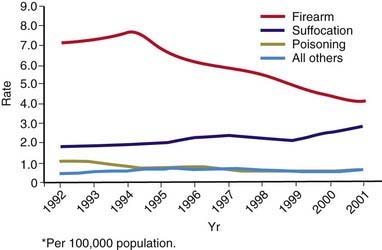
Figure 25-1 Annual suicide rates among persons aged 15-19 yr, by year and method, United States, 1992-2001.
(From Centers for Disease Control and Prevention: Methods of suicide among persons aged 10–19 years, United States, 1992–2001, MMWR Morb Mortal Wkly Rep 53:471–474, 2004.)
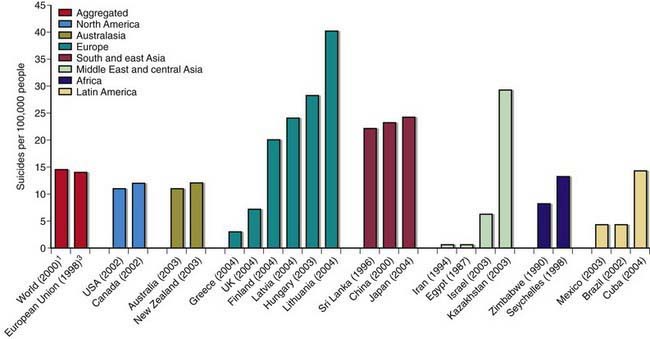
The ethnic groups with the highest risk for completed suicide are American Indians and Alaska Natives. Within this population, suicide is the second leading cause of death, accounting for nearly 1 in 5 deaths among youth ages 15-24 yr. The ethnic groups with the lowest risk are African-Americans, Hispanics, Asians, and Pacific Islanders. The suicide rate among African-American, Hispanic, and other minority males has continued to increase, and the rate among white males has remained steady. Suicide risk also varies in different countries (Fig. 25-2).
Risk Factors
Pre-existing Psychiatric Illness
The great majority (estimated at 90%) of youths who complete suicide have a pre-existing psychiatric illness, most commonly major depression (Chapter 24.1). Among girls, chronic anxiety, especially panic disorder, also is associated with suicide completion (Chapter 23). Among boys, conduct disorder and substance use convey increased risk. Comorbidity of a substance use disorder (Chapter 108), a mood disorder (Chapter 24), and conduct disorder (Chapter 27) has been linked to suicide by firearm.




