Age, mean (SD)
19.5 (3.3)
Years of education, mean (SD)
7.7 (2.8)
Marital Status, %
Married
42.2
Never married
50.1
Formerly married
7.7
Number of living children, %
0
50.6
1
26.4
2
16.8
3+
6.2
Sample size
1,497
The second source of data comes from a qualitative project nested within TLT.4 The project was designed to examine how household or personal experience with HIV infection affects the way people think about HIV. In total, 44 interviews were conducted with a subsample of TLT respondents who either lived with someone who was HIV positive and not on ART, lived with someone who was on ART, had HIV themselves, or had no direct household contact with someone with a known HIV infection. Respondents were recruited based on their responses to TLT questions at Wave 6. The analyses presented here focus on respondents who acknowledged they were HIV positive (n = 16; 10 women, 6 men).5 Apart from questions on their experience with HIV and ART, interviewers asked about respondents’ plans for the future with particular emphasis on their childbearing plans and whether and how these plans were affected by their disease.
5 Results
5.1 Social Norms Around HIV-Positive Childbearing
We begin by describing social norms around HIV-positive childbearing. At their first interview, respondents were asked how they would advise a series of hypothetical female friends about their childbearing in a set of slightly altered vignettes. The commonality across the scenarios is that the female friend in question would like to have another child. In other words, the friend’s desire for another child does not vary across the three vignettes.
In the first scenario, a friend named Lucy and her husband are both HIV-positive. They have four children but would like another child. Only 11% of women in the TLT sample reported that they would advise Lucy to have another child. The second friend, Agnes, is similar to Lucy in all respects except that she does not yet have any children. In this case, 30% of respondents said they would advise her to have children. In the last scenario, respondents are asked about Emily, a woman who has four children and both she and her husband are HIV-negative. This last scenario was designed to assess general norms around childbearing. Fifty-eight percent of respondents reported that they would advise her to have more children if she wanted them. What these vignettes tell us is that 42% of young women in Balaka think that people should not have more than four children even if they want them and are not infected with HIV. Once we introduce HIV into the picture, the story changes. Respondents are much more likely to advise their HIV-positive friends to stop having children regardless of the number of children they already have. But that is not the complete story. Almost three times as many women report a willingness to advise a friend to have children even if she is HIV-positive if she has no children as would advise a friend who already has four. In other words, norms around HIV-positive childbearing are contingent on the specific situation and, in particular, the number of children a woman already has.
At Wave 1, there are only a small number of women (n = 19) who acknowledge in the survey that they are HIV-positive. With such a small number, we must be cautious in drawing conclusions, but nonetheless it is informative to look at their responses to these same questions. How do women who are positive themselves view HIV-positive childbearing? Their responses to childbearing are very similar to the sample at large for women who have four children, regardless of their HIV status. However, when asked whether an HIV-positive woman should have children if she has none already, 74% of these women reported supporting the decision—more than twice as many as the rest of the sample (Table 6.2).
Table 6.2
Vignettes: women who would advise their friend to have a/another child
LUCY: | AGNES: | EMILY: | |
|---|---|---|---|
both HIV+, 4 children | both HIV+, 0 children | both HIV-, 4 children | |
Women who are not HIV-positive (or do not know they are) (n = 1,478), % | 11.2 | 29.8 | 57.9 |
Women who know they are HIV-positive (n = 19), % | 10.5 | 73.7 | 52.6 |
5.2 The Fertility Preferences of HIV-Positive Women
Using the TLT Wave 5 data, we are able to examine the personal fertility preferences of HIV-positive and -negative women. Approximately 60% of respondents were offered (and accepted) testing by the end of Wave 4.6 We examine Wave 5 responses to the question on whether or not respondents want to have a/another child by the number of children respondents currently have. Although the question on fertility preferences was also asked at Wave 4, we use Wave 5 responses because it is important to our inquiry that respondents are aware of their status at the time they answered the question.
Figure 6.1 shows the desire to continue childbearing by HIV status and parity for the 628 HIV-negative and 72 HIV-positive women in our sample who were reinterviewed at Wave 5 and not currently pregnant (n = 128 for excluded due to pregnancy). Among women without any children, there is no difference in the desire to continue childbearing between those who are HIV-positive and those who are HIV-negative—they essentially all want to have children. Moving to examine women who already have one child, a gap emerges—while the vast majority of women want to have more children, HIV-positive women are less likely than HIV-negative women to report wanting more. This gap continues to grow—in a nonlinear fashion—as parity increases. By the time we get to women who have three or more children, just over one-fifth of HIV-positive women express a desire to continue childbearing compared with approximately three-quarters of women who recently tested negative. T-tests confirm that the differences between the two groups are significant beginning at women with one child (p-value <0.01).
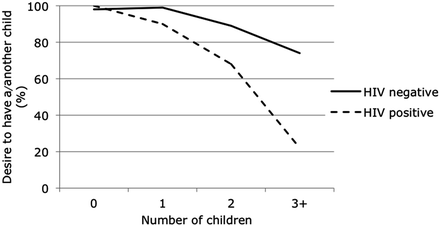
Fig 6.1
Desire to continue childbearing by HIV status and parity (Source: Tsogolo la Thanzi, Wave 5, 2010)
The reported preferences of women based on their HIV status and number of children mirror the reported social norms with one notable difference. HIV-positive women with no children universally expressed (n = 16) a desire to have children. When asked to advise a friend, only three-quarters of HIV-positive women reported advising a friend to have children in this circumstance. Still, the actual preferences of HIV-positive women with no children are more similar to the hypothetical advice of HIV-positive women than to that of HIV-negative women, only 30% of whom would advise a friend to have children if she was HIV-positive and had no children.
5.3 The Voices of HIV-Positive Women
The survey findings offer a good picture of social norms around HIV-positive childbearing and the fertility desires of HIV-positive and -negative women by parity. However, they fall short in aiding our understanding of how HIV-positive women themselves articulate their childbearing desires. Here, we use the qualitative data to explore women’s own voices, focusing on how they explain their fertility desires through the lens of their own particular situation.
Young people in Balaka are generally aware of the resources available for HIV-positive women to have children. Virtually, everybody we interviewed made some reference to existing hospital services that help prevent transmission of HIV from mother to child. Not all women knew the details of the program, and fewer still knew the name of the exact medicine (nevirapine), but they all, HIV-positive and -negative alike, seemed to know that it was important for HIV-positive pregnant women to go to antenatal clinic earlier than usual and to take certain medicines. Respondents expressed concerns about breastfeeding and the risk of a child “sucking” the disease. Many were aware of the current recommendations that HIV-positive women should stop breastfeeding after 6 months to limit the likelihood of passing the virus on, but they also expressed doubts about the feasibility of this strategy given that there are few realistic alternatives in this setting. See also Chaps. 10 and 11 in this volume.
When asked about their childbearing plans, most HIV-positive women voiced desires to have children in the future. This was particularly true of those with no or few children. Janet, a 25-year-old HIV-positive woman with no children, responded the following when asked about her childbearing plans:
J: …though I was found with the virus but still I want to have only one child.
I: Why do you want to have one child only?
J: Just that…(laughing)….
I: …(laughing)…how many children does your mother have?
J: My mother has 7 children.
I: So you want to have one child only?
J: Because, the problem is that since I was found with it, we rushed…(both laughed) Yes, the problem is that we rushed…(laughing).
The interviewer clarified that the woman meant that she and her husband “rushed” to get this disease because they contracted it so young in life. Later in the interview, she added:
J: …what I get anxious most is about the child because I don’t have a child, yes, where I get anxious so much is there.
I: Actually what are your anxieties?
J: I want to, I already said that I want to have at least one child right. [Pause.] But the child, I want to try my best so that the child should not contract it also.
Despite being 25 and married, Janet does not yet have children. She makes it clear to the interviewer that she is anxious about not having a child and that she strongly desires one. At the same time, she states that, because she and her husband have HIV, she will stop at one child.
The absolute number of children a woman has is only part of her decision of whether or not to have more. Equally, in a context where divorce and remarriage are extremely common, and children are needed to cement a relationship, having children within new unions is vital to their stability. Grace, a 25-year-old HIV-positive woman, provides a good example of this. She and her ex-husband have two children together, one of whom has full blown AIDS. She recently remarried a man who is aware of her status.
G: I have said that I have two children. This husband has just married me recently, it cannot be possible for him. Had it been that maybe he is the husband who gave me the children and I am staying with him, while I know that I have given birth for him the two children and then been found with that kind of problem, then we could have agreed that we should stop giving birth… here, but for the person who has just married me recently, him too will want that, since we have been found with this kind of problem. I too am supposed to have my one child. I should be having courage when staying where, staying here. So those are what can cause that maybe I will give birth because of that kind of problem. Yes but if I can give birth to one child maybe that will be the end because the husband will know that, “I have given birth, this is my child”, but we have this kind of problem, for us to protect ourselves, or that we should stay, we should be staying that we should stand still we are supposed not to give birth again.
For women who are HIV-positive but already have a number of children with their current partner, the thought process differs. Mercy, a 26-year-old woman, learned she was HIV-positive when she attended an antenatal clinic during the pregnancy of her fifth, and most recent, child. She describes how learning she was HIV-positive led her to get a tubal ligation after the birth, but she also speculates that if she had a small number of children, her calculation would have differed.
I: What role do you think HIV will take on the part of your having other children?
M: Currently?
I: Yes.
M: I cannot say that things will be like this because when this one [infant with her] had just been born, I said that “I do not need to continue, no. I should just stop right here.” And I stopped from this one.
I: Are you telling me that you stopped giving birth?
M: I followed contraception methods of never giving birth.
I: You followed contraceptive methods of never giving birth?Stay updated, free articles. Join our Telegram channel

Full access? Get Clinical Tree



