(1)
Department of Emergency Medicine, Erasmus Medical Center, Rotterdam, The Netherlands
Sensitivity tells you how good the test is for finding _________? | Positives (people with the disease, people who respond, etc.) |
How do you calculate sensitivity? (no panic allowed!) | 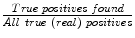 (True positives with positive results ÷ The total number of positives that should have been found) |
Specificity tells you how good a test is for finding ___________? | Negatives – Correctly ruling out the negatives (people without disease, people who don’t respond, etc.) |
How do you calculate specificity? | 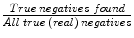 (True negatives with a negative result ÷ The total number of negatives that should have been found) |
What does “prevalence” mean? | The fraction of the population that has whatever you are looking for (For example, if 5 of 100 people in the population have DM, then the prevalence is 5/100 or 0.05) |
Do sensitivity and specificity change, depending on the prevalence of a disease? | NO (they are prevalence independent ) Note: The “predictive value” tests will change with prevalence |
A popular test item asks what will happen when you move a screening test’s threshold up or down. If you raise a test’s threshold, so that it is harder to get a positive result, what is the effect on the sensitivity? (For example, if you were using 100 as the cutoff for a normal glucose, and you increase that to 120, will you find more, or fewer, diabetics?) | It’s decreased You will find fewer diabetics (missing more true positives) |
What if you move your test’s threshold so that it is easier to get a positive result? What will happen to sensitivity then? (For example, if you change your glucose threshold from 120 to 105 for a diagnosis of possible DM . . .) | Sensitivity will be great! (You will find nearly all true positives!) Mnemonic: Remember sensitivity by thinking of someone with “sensitive skin.” If you send them into the woods to test for poison ivy, and it’s there – they’ll find it for you! If you send a non-responder (low-sensitivity skin), you’ll never know it was there. |
When you move a test’s threshold so that it’s harder to get a positive result (e.g., a glucose of 200 to qualify for DM, instead of 120) what does that do to specificity for the test? | Better specificity – When you say the patient has DM, you’ll almost always be right! Mnemonic: Think of “specificity” as a high anxiety kind of a gal. She doesn’t want to make a mistake, so she’s reluctant to answer unless she’s certain she’s right. When specificity is high, almost everyone selected will be a true positive (but a bunch of true positives are often missed!) |
What effect does it have on specificity, if you move your test’s threshold, so that it is easier to get a positive result? | Specificity is lower – You’re now identifying lots of people who don’t have the disease, in addition to those who do. |
Does the positive predictive value (PPV) statistic depend on the prevalence of a disease? | Yes |
Positive predictive value is classically used in what setting? (popular test item) | To decide whether something should be used as a screening test |
In words, what does the “positive predictive value” tell you? | How valuable, or useful, it is to you as a clinician, if you get a positive result for a patient If the test’s positive predictive value is high, then the clinician can feel confident that a positive result means the patient really is positive, in nearly every case. |
How do you calculate the positive predictive value of a test? | 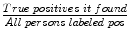 (True positives with positive results ÷ Total number of positive results) |
What about negative predictive value – what does that mean, in regular words? | It is how confident you can be that a negative result is a true negative |
How do you calculate the negative predictive value of a test? | 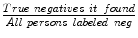 (True negatives with negative results ÷ Total number of negative results) |
If you have to calculate something on the exam, what size of population should you assume if that information is not given? | 1 million or 100,000 usually make for the easiest calculations |
Odds ratio – How on earth can I remember how to calculate the odds ratio? | Step 1 – Make a 2 × 2 table for whatever is being compared. Don’t worry about which label you put where. Step 2 – Identify the cells that match (+result & +disease, for example), and the cells that are mixed (+result & no disease, for example) Step 3 – Multiply the ones that match over the ones that are mixed |
What does the odds ratio formula look like, without the steps? |  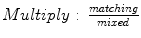 |
If you raise a test’s threshold, what happens to the specificity? | It’s improved There are fewer false positives |
What is a 95 % confidence interval? | The range of values in which the true value will be found – in 95 % of cases |
As an example, if we measured the height of men from Norway, and found that the average height in our sample was 6 feet 2 in., and the heights of our subjects were pretty similar (little variation), a sample 95 % confidence might be . . .? | Mean of 6 feet 2 in. with a 95 % confidence interval of +/− 2 in. (The true value, with 95 % confidence, lies somewhere between 6 feet and 6 feet 4 in.) |
If a confidence interval is given for a statistic that can work out to zero, then how can you tell whether it is statistically significance? (For example, a risk difference statistic) | If the confidence interval includes zero (often referred to as “crossing zero”), then the result is not significant – (because zero would mean no difference) If it does not cross zero, it is significant |
If a confidence interval is given for a statistic that can work out to one, how can you tell whether it is a statistically significant result? (For example, an odds ratio or relative risk) | If the confidence interval includes 1.0, then the result is not significant – (because one would mean no difference) If it does not cross one, it is significant |
Standard deviations & standard error are not reported very much in current medical literature. They are still in the curriculum for pediatrics, though. In general terms, what is a “standard error” & with what kind of data could you use it? | Standard error measures how much variation is in the data collected It is used for regular number data (things like height) (Example: If you were studying height, and in your sample you had people who were very short through very tall, then the standard error would be large.) |
What is standard deviation, then? | It tells you, in numerical form (in numbers), how close to the mean most of the studied population lies (standard error is used in calculating the standard deviation, so they are closely related)
 Stay updated, free articles. Join our Telegram channel
Full access? Get Clinical Tree
 Get Clinical Tree app for offline access

|